
The Modern Guide to Oily Skin in Perimenopause: How to Balance Your Skin During Hormonal Changes
Here’s a confession: everything the skincare industry taught us about oily skin in the 1980s and ’90s was, at best, incomplete—and at worst, actively counterproductive. If you spent those decades pressing alcohol-soaked pads against your face in a daily war against shine, you already know how the story ends. Dry patches. Persistent breakouts. And oil that returned with a vengeance by midafternoon.
Now fast forward to perimenopause, and the problem has returned—but in a more complex form. Hormonal skin changes have reintroduced oiliness alongside dryness, acne alongside sensitivity, and the familiar temptation to strip everything away alongside a skin barrier that can no longer afford to lose what little protection it has left.
If you’re navigating perimenopause oily skin, the most important thing you can learn is this: the approach that failed you at seventeen will fail you more spectacularly now. Your skin’s biology has fundamentally changed, and it needs a strategy that respects that change rather than ignoring it.
When Perimenopause Brings Back Oily Skin: Understanding the Hormonal Mechanics
Our founder, Joy Kirst, knows this story personally. When perimenopause arrived with oily skin and hormonal acne in tow, her first instinct was to reach for the familiar arsenal. Instead, she chose to research—and what she discovered upended decades of conventional wisdom about perimenopause skincare.
The core insight: during perimenopause, estrogen and progesterone decline while androgens (particularly testosterone) decline more slowly, creating a period of relative androgen dominance. This hormonal imbalance stimulates the sebaceous glands to increase sebum production, resulting in oiliness, congestion, and perimenopause skin breakouts—often concentrated along the jawline and chin.
But here’s the critical nuance that changes everything: at the same time your oil production is fluctuating upward, your skin’s barrier function is deteriorating. Estrogen loss reduces ceramide production, thins the dermis, and compromises your skin’s ability to retain moisture. The result is a paradox that defines perimenopause and skin problems for millions of women: oily skin that is simultaneously dehydrated.
This is why stripping oil—the instinct burned into us from adolescence—backfires so dramatically during perimenopause. When you remove the protective lipid layer from already barrier-compromised skin, the skin panics and overproduces sebum to compensate. You haven’t solved the problem. You’ve intensified it.
The Oil Paradox: Why Adding Oil Helps Oily, Perimenopausal Skin
This is the counterintuitive truth at the heart of effective skincare for menopausal skin with oily tendencies: your skin needs more moisture, not less. Specifically, it needs the right kind of moisture—delivered in a way that signals to your sebaceous glands that the barrier is intact and overproduction is unnecessary.
Facial oils high in linoleic acid—often called “dry oils” for their lightweight, fast-absorbing texture—are the key. Unlike oleic acid-dominant oils (which can feel heavy and exacerbate congestion), linoleic acid-rich formulations absorb readily, support the skin’s lipid barrier, and help regulate sebum production rather than adding to the problem.
When Joy couldn’t find a formulation that delivered this balance—one that would calm oiliness, address breakouts, deeply moisturize dry patches, and soften fine lines simultaneously—she spent years developing her own. That formulation became The Innovator, Modern Age Skin’s Luminous Repair Oil: a lightweight, linoleic acid-rich facial oil designed specifically for the paradox of perimenopause oily skin that is simultaneously dehydrated and barrier-compromised.
The skeptics Joy shared early formulations with—women who had sworn off facial oils after decades of oily skin—became its most passionate advocates. Because when you give your skin what it actually needs, the results speak for themselves.
Morning Routine: A Skin Care Routine for Mature Skin with Oily Tendencies
A consistent, streamlined routine is essential for managing perimenopause oily skin. The goal isn’t to eliminate oil—it’s to balance production, maintain barrier integrity, and prevent the congestion that leads to breakouts. Fewer products, chosen with precision, will outperform a twelve-step regimen every time.
1. Cleanse
Begin with a mild, pH-balanced cleanser that removes overnight buildup without stripping your barrier. This is non-negotiable for perimenopause skincare: soap-based and foaming cleansers are too aggressive for skin that’s simultaneously oily and barrier-compromised.
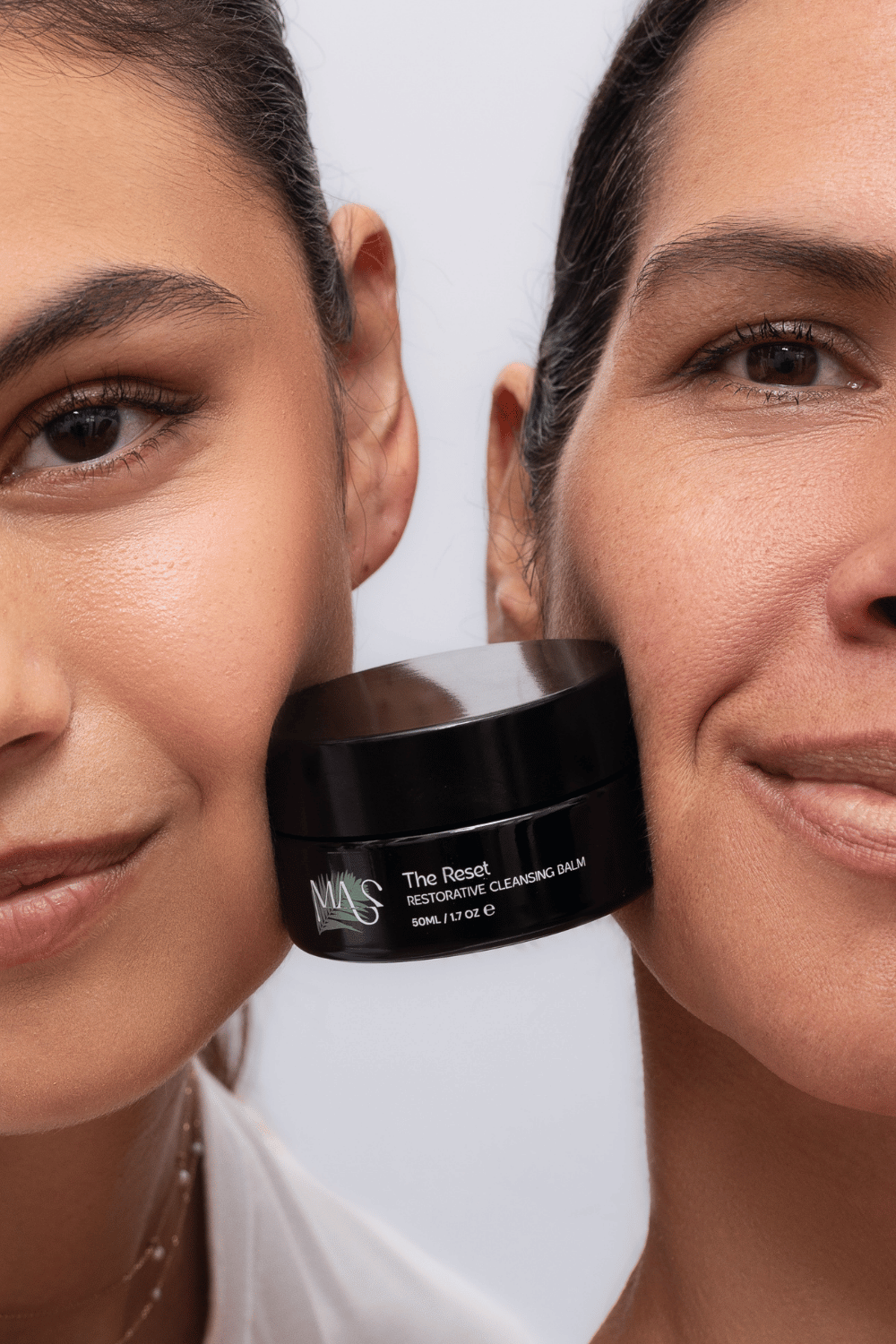
The Reset—our Restorative Cleansing Balm—was formulated for exactly this balance. It cleanses thoroughly without the alkalinity that triggers the overproduction cycle, leaving skin clean, soft, and protected.
2. Tone (Optional but Recommended)
A hydrating toner for mature skin serves two purposes: it provides a lightweight layer of moisture that rebalances the skin after cleansing, and it helps subsequent products penetrate more effectively without adding excess oil. Look for formulations containing hyaluronic acid and niacinamide—both excellent for managing oiliness while delivering the hydration perimenopause skin needs.
3. Moisturize
For the moisturizing step, choose lightweight, non-comedogenic formulations that seal in moisture without clogging pores or adding heaviness. Gel-based moisturizers work beautifully for oily zones, while a few drops of a linoleic acid-rich facial oil can address dry patches without triggering sebum overproduction.
The best moisturizer for perimenopause oily skin should be free from heavy silicones, rich in barrier-supportive ingredients like ceramides and niacinamide, and lightweight enough to layer under sunscreen without creating a greasy base. The Innovator excels here—its formulation absorbs quickly and leaves a luminous, balanced finish rather than a slick one.
4. Sunscreen
Non-negotiable, every single day, regardless of season or weather. UV exposure accelerates every aspect of menopausal skin changes and undermines every other product in your routine. Choose a lightweight, non-comedogenic SPF 30 or higher that won’t exacerbate oiliness. Many modern facial sunscreens double as a hydrating primer for mature skin, providing sun protection and a smooth base for makeup in a single step.
Evening Routine: Deeper Care for Perimenopausal Skin
Your nighttime routine is where targeted treatment happens. Your skin’s repair cycle is most active while you sleep, making the evening the optimal window for actives that address perimenopause skin breakouts, texture, and cell turnover.
1. Cleanse
Begin with an oil-based or balm cleanser to dissolve makeup, sunscreen, and the day’s accumulation of sebum and environmental residue. Yes, oil removes oil effectively—this is the same principle that makes linoleic acid work for oily skin.
The Reset functions as a double-cleanse in one: its blend of oils and butters dissolves makeup and sunscreen (including mascara) when applied to dry skin, then transforms into a gentle, pH-balanced foam when water is added. Skin is left clean, soft, and barrier-intact.
2. Treat
This is the step where you address the specific skin changes perimenopause brings. A nighttime treatment serum with gentle AHAs or BHAs helps clear pores prone to congestion, improves texture, supports the slowing cell turnover that characterizes hormonal transition, and addresses perimenopause skin breakouts without the aggression of teenage acne treatments.
The Catalyst—our Nightly Renewal Complex—delivers bioactive botanicals and peptides designed to support your skin’s natural repair cycle. It helps clear congestion, improve tone and texture, and support collagen—all critical for skin that’s navigating the dual challenge of oiliness and aging.
3. Moisturize
Finish with a few drops of a well-formulated facial oil. Despite having oily skin, your mature skin still needs the right kind of moisture to support its barrier function overnight. The Innovator provides deep, barrier-reinforcing nourishment while you sleep—and you’ll wake to skin that feels balanced, smooth, and genuinely hydrated rather than greasy.
When Oily Meets Dry: Managing Multiple Perimenopause Skin Problems
One of the most frustrating aspects of perimenopause and skin problems is that concerns rarely arrive in isolation. Your skin may be oily across the T-zone, dry along the cheeks, sensitive everywhere, and breaking out along the jawline—all simultaneously. Here’s how to address the most common combinations:
Oily Skin with Dry Patches
This is the hallmark paradox of perimenopause. The solution isn’t choosing between hydration and oil control—it’s applying the right formulation to each zone. Use lighter gel-based moisture on oily areas and richer, barrier-supportive products on dry patches. A linoleic acid-rich facial oil can be applied to dry zones specifically, or used all over in smaller amounts.
Breakouts with Sensitivity
Perimenopause skin sensitivity often accompanies breakouts, making traditional acne treatments too harsh. Prioritize gentle chemical exfoliants (PHAs or low-concentration AHAs over aggressive BHAs), calming ingredients like niacinamide and centella asiatica, and fragrance-free formulations across your entire routine. Your barrier is already compromised—don’t strip it further in pursuit of clear skin.
Itching, Texture Changes, and Emerging Sensitivity
These less visible concerns are equally common. Perimenopause skin itching is often caused or worsened by over-cleansing oily skin, which destroys the barrier that prevents moisture loss and irritation. Changes in pore size, texture, and tone distribution are all driven by the same hormonal shifts affecting oil production. The solution across all of these: rebuild and protect the barrier first, then address individual concerns with targeted, gentle interventions.
Beyond Topical Care: Supporting Your Skin from Within
While the right skincare for menopause is essential, internal support can meaningfully complement your topical routine—particularly when it comes to regulating oil production and managing the inflammation that drives hormonal breakouts.
• Omega-3 fatty acids: Help regulate sebum production and reduce systemic inflammation—beneficial for both oily skin and the perimenopause skin breakouts it can trigger
• Evening primrose oil: Supports the hormonal balance that directly affects sebum production
• Zinc: Helps control oil production and supports healing of hormonal acne
• Vitamin B complex: Particularly B3 (niacinamide), which regulates oil production and strengthens the barrier when taken internally as well as applied topically
• Hydration, stress management, adequate sleep, and an antioxidant-rich diet: These foundational practices support every aspect of skin function and create the conditions under which your topical routine can work most effectively
Your Skin Isn’t Broken—It’s Navigating a Transition
The best skincare for menopausal skin with oily tendencies is fundamentally different from what we were taught in our youth. Those alcohol pads, astringent toners, and mattifying powders were designed for adolescent skin with an intact barrier and abundant collagen. Your skin at this stage of life has neither—and it needs care that reflects that reality.
By understanding the hormonal skin changes driving perimenopause oily skin, you can stop fighting your biology and start working with it. Nourish rather than strip. Balance rather than battle. Choose menopause skin care products formulated for the specific paradox of oily-yet-dehydrated skin that defines this transition.
Your skin isn’t broken. It’s simply asking for a different kind of care—one that’s as sophisticated as the changes it’s navigating. That’s precisely why Modern Age Skin exists.
For more evidence-based guidance on managing oily skin during hormonal transitions, the American Academy of Dermatology Association offers helpful recommendations from dermatologists on caring for oily skin at every stage of life.
Skincare that works with your biology, not against it. Explore Modern Age Skin at modernageskin.com.

Written by Joy Kirst
Joy Brown Kirst is the founder and formulator of Modern Age Skin, an award-winning clean beauty brand specializing in perimenopause and menopausal skincare. With an MBA from Rice University and over 20 years of experience in corporate leadership and entrepreneurship, Joy brings strategic business expertise to the beauty industry.
Following her successful career in the executive search industry, Joy earned her Diploma in Organic Skincare Formulation from Formula Botanica (2021), combining her business acumen with botanical expertise to create bioadaptive, results-driven formulas for hormonal skin changes.
Modern Age Skin’s hero product, The Innovator - Luminous Repair Oil, has won both the Shape Skin Award for Best Facial Oil (2024) and the Healing Lifestyles Earth Day Beauty Award (2025). The brand is Power Beauty Collab certified and Leaping Bunny Certified, reflecting Joy’s commitment to clean, cruelty-free beauty.
Joy and Modern Age Skin have been featured in Forbes, BeautyMatter, Well Defined, on television with Pix 11 in NYC, and on the Well Done, Thrive After 45, and Midlife Mavericks podcasts. Through her work, Joy is redefining skincare for women navigating hormonal transitions, proving that aging skin deserves sophisticated, science-backed solutions.

Leave a comment
This site is protected by hCaptcha and the hCaptcha Privacy Policy and Terms of Service apply.