

The Handover Principle
Estrogen ran five systems in your skin for thirty years. When it withdraws, the work transfers. Everything we formulate follows from that.
You are not imagining it
Somewhere in your forties, the routine that worked for two decades quietly stops working.
Moisturizer that used to last all day is gone by noon. Foundation settles into places it never used to find. Your cheeks flush at things that never bothered you before. Your jawline looks softer in photographs than it does in the mirror. And an itch arrives — on your shins, your back, the inside of your forearms — for no reason you can name.
Most women are told this is simply aging, and to be patient with it.
It isn't simply aging. What is happening is more specific, better understood, and considerably more actionable than that.
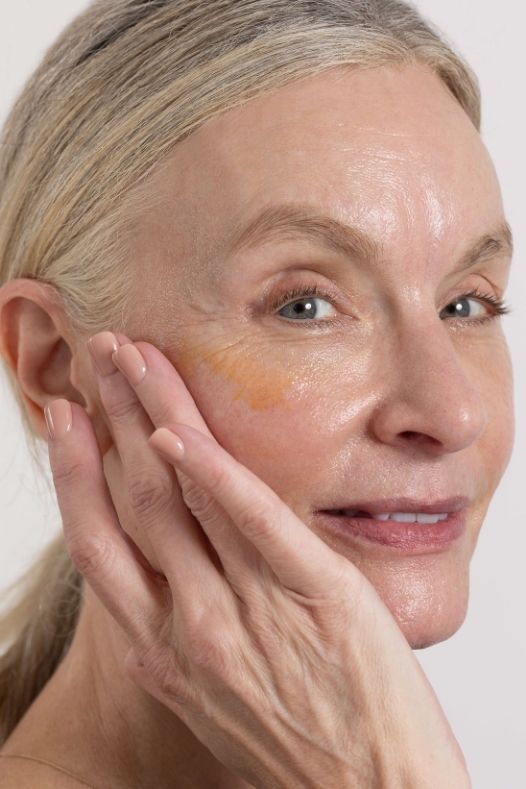
The Handover
Estrogen is not a beauty hormone. It is a maintenance hormone.
Receptors for it sit throughout your skin — in the cells that build collagen, in the glands that produce oil, in the layers that hold water. For roughly thirty years, estrogen used those receptors to run five systems on your behalf: hydration, structure, barrier, renewal, and defense. It did this continuously, and it never asked you for anything.
Perimenopause is when that management begins to withdraw. Not smoothly, and not all at once — erratically, over several years, which is exactly why the changes feel so inconsistent and so difficult to describe to anyone. Menopause is the point at which the withdrawal becomes permanent.
This is the handover.
The five systems do not disappear. They simply stop being run for you, and start needing to be run by you.
That is a different relationship with skincare than the one you have had until now. It is also a considerably more powerful one — because for the first time, what you put on your skin is not maintenance in addition to the work. It is the work.
The Five Systems, In Practice
Five systems, five sets of changes. Most women recognize themselves in three or four of them at once — which is why the experience can feel so scattered until you see it laid out.
Moisturizer that's gone by noon.
What's underneath
Estrogen supports both hyaluronic acid and oil production. As it falls, skin holds less water and loses more of what it has.
What it needs
Humectants to draw water in, lipids to keep it there. Most routines only do the first.
A jawline that looks softer than it did.
What's underneath
Collagen gives density, elastin gives recoil. Both are estrogen-responsive, and the decline front-loads in the first years after your final period.
What it needs
Nightly support for density and elasticity, over years rather than weeks. Starting earlier matters most here.
An itch with no rash and no cause.
What's underneath
Your barrier is a lipid seal. As it thins, water escapes and nerve endings sit closer to the surface. Itch is often the first sign of the handover — and the one most women dismiss.
What it needs
Put lipids back, and stop taking them away. Most routines fail at the cleansing step.
Skin that looks tired on days you aren't.
What's underneath
Turnover slows. Older cells linger at the surface, scattering light instead of reflecting it. That reads as dullness.
What it needs
Encouragement, not force. Gentle renewal beats resurfacing that costs you barrier.
Pigment that arrived and never faded.
What's underneath
Estrogen supports antioxidant capacity and pigment regulation. With less of it, environmental damage does more and lasts longer.
What it needs
Antioxidants every morning, sun protection every day. No seasonal exceptions.


The handover is not a single event. It happens in three phases, and each one asks something different of your skin.
Where you are
Typically the forties to early fifties Estrogen: fluctuating, and beginning to decline
Levels swing rather than fall. Your skin may be dry one month and oilier the next, calm for a season and reactive the next — and the inconsistency itself is the signature. Structural change has begun but is not yet obvious.
Where to put your effort: Barrier and Hydration first. This is the window in which protective habits do the most work for the least effort.
Twelve months after your final period. Average age, 51. Estrogen: sharply lower
The fluctuation resolves into a consistently low baseline. Structural change becomes visible — firmness, density, and the way skin sits along the jawline and neck. Dryness stops being intermittent and becomes constant.
Where to put your effort: Structure and Hydration, with Barrier maintained continuously underneath both.
Twelve months onward Estrogen: low and stable
The pace of change slows considerably. What remains is cumulative, and the priority shifts from adjustment to maintenance — protecting what you have, consistently, over a long horizon.
Where to put your effort: Defense and Renewal, on a foundation of Barrier and Hydration that never comes out of the routine.
What Your Skin Needs Now
Five systems. Six steps. Twice a day.
A routine that supports all five systems does not need to be long. It needs to be deliberate, and it needs to be the same tomorrow.
Cleanse lightly.
Water, or The Reset
Most mornings, water is enough. Skin that was clean at bedtime does not need stripping again before breakfast.
BarrierHydrate, then seal.
Lightweight enough for morning, and it does both halves of the job — draws water in, then keeps it from leaving.
HydrationBarrierProtect.
Not ours — see below
Sun protection, every day. Not seasonally, and not only when it is bright. Of the five systems, this is where a daily habit changes the most.
DefenseCleanse properly.
A balm, not a foam. It lifts the day off without taking the lipids with it — which is where most routines quietly lose ground.
BarrierRenew and rebuild.
Gentle exfoliation with hydration built in, plus Densorphin at 2% — a monk's pepper extract studied in women over 50 for skin density and elasticity. This is the step that compounds.
RenewalStructureHydrationSeal it in.
Oil goes last. Everything underneath stays where you put it, through the hours when skin loses the most water.
HydrationBarrierAll five systems, three products
On sun protection
We don't make a sunscreen, and we'd rather tell you what to use than leave the most important step of your morning unsaid. Two we recommend without reservation: Ilia Super Serum Skin Tint SPF 40, if you want protection and coverage in one step, or Saint Jane Luxury Sun Ritual SPF 30, if you prefer to keep them separate.
Questions women actually ask
It can be, and it is one of the most commonly missed ones. As estrogen declines, the lipid matrix that seals your skin thins, water escapes more easily, and nerve endings sit closer to a less protected surface. The result is an itch that often has no rash and no obvious cause — frequently on the shins, back, and forearms, and often worse at night. Persistent or severe itching should always be discussed with your doctor, since other conditions can cause it. But if it arrived alongside other changes in your forties, hormonal shift is a reasonable first thing to consider.
Two things fell at once. Estrogen supports both hyaluronic acid production and sebaceous gland activity, so your skin is holding less waterandproducing less of the oil that would keep it from evaporating. This is why moisturizer alone often stops being enough — it addresses the first half of the problem without the second.
Yes, and it is more common than most women expect. As estrogen falls, the balance between estrogen and androgens shifts. Some women see increased oil through the T-zone alongside genuine dryness elsewhere — sometimes with breakouts they have not had since their twenties. It is not a contradiction, and it does not mean you are treating your skin wrong.
Earlier than most women do. Barrier and hydration changes generally begin during perimenopause, while estrogen is still fluctuating — often years before anything structural is visible. Adjusting when you first notice tightness, sensitivity, or itch is considerably more effective than waiting for firmness to change.
We do not recommend them, and we do not formulate with them.
Retinoids are well studied and genuinely effective for many people. But maturing skin during and after the handover is contending with a thinner lipid barrier and heightened reactivity, and retinoids work in a way that puts additional demand on exactly that barrier. For sensitive skin in this phase, the cost is frequently higher than the return — irritation, prolonged redness, and a routine abandoned before it could do anything.
Our position is that consistency you can sustain outperforms intensity you cannot. If you use a retinoid successfully and your skin tolerates it well, there is no reason to stop. If you have tried and found it unmanageable, you have not failed at skincare.
Topical estrogen is a prescription medicine and a conversation for your doctor. Phytoestrogens — plant compounds structurally similar to estrogen — appear in a number of cosmetic products, and the research on their topical effect in skin is still developing rather than settled.
We take a deliberate position here: we do not make claims about hormonal activity, because a cosmetic product is not permitted to and the evidence would not support it if it were. What we can support is the appearance of hydration, comfort, and firmness — and that is what we formulate for.
For the structural changes, the evidence suggests it does. Collagen decline is reported to be steepest in the first years following the final period rather than spread evenly across the decade, which means the years leading up to it are the ones in which good habits compound. For barrier and hydration, the answer is simpler: those changes are already underway during perimenopause, so support is useful the moment you notice them.
They change on the same schedule and are usually neglected on the same schedule. The skin at the neck and chest is thinner than facial skin and shows structural change earlier. Whatever you do for your face, extend it downward — it costs almost nothing and it is the single most common gap we see.
Continued Reading
The Science: how we formulate for The Handover
The Consultation: find your routine
Journal - Dry Sensitive Skin During Perimenopause & Menopause